
California Colleges & Universities
Top college and university libraries in California
These college and university libraries stand out for their collections, special collections and archives. Public access varies, so each entry says how visitors can use the library.
Stanford University LibrariesStanford University
Stanford's twenty campus libraries hold more than fifteen million items, including over eleven million physical volumes. Green Library, the largest on campus, houses the humanities and social sciences collections and the David Rumsey Map Center, which holds well over ten thousand rare maps, globes and atlases. Special collections include hundreds of thousands of rare books, medieval manuscripts, cuneiform tablets and papyri, the Silicon Valley Archive and nearly half a million recordings in the Archive of Recorded Sound. Visitors doing research can get a day pass, good for up to seven days a year, by registering in person with a government-issued photo ID. Materials are for on-site use only.
UC Berkeley LibraryUniversity of California, Berkeley
The UC Berkeley Library holds more than 15.2 million volumes in over 400 languages. Doe Library anchors the system and is open to all visitors with no ID or registration needed. The Bancroft Library, on the east side of Doe, dates from 1905, when the university acquired Hubert Howe Bancroft's library of books about California and the West. It is one of the largest and busiest special collections libraries in the country and includes the Mark Twain Papers, the Oral History Center and the University of California Archives. Bancroft researchers must be 18 or older and show photo ID. California residents can buy a one-year borrowing card for $100.
UCLA LibraryUniversity of California, Los Angeles
The UCLA Library collection numbers 19 million titles, and about 4 million items from its digital collections are online. The Charles E. Young Research Library is home to UCLA Library Special Collections, which is open to everyone 18 and older. Its rare books, manuscripts, photographs and archives are used in the Ahmanson-Murphy Reading Room, and the Center for Oral History Research records the history of Los Angeles and Southern California. Powell Library, one of UCLA's four original Westwood buildings, serves undergraduates. Members of the public over 18 can get a free access-only card, or buy a $100 yearly borrower card with a government-issued photo ID.
USC LibrariesUniversity of Southern California
The USC Libraries hold 6.5 million volumes and 85,000 linear feet of archival collections. Their landmark building, the Edward L. Doheny Jr. Memorial Library, opened in 1932 as USC's first freestanding library. It also houses the Cinematic Arts, East Asian and Music libraries and Special Collections. ONE Archives at the USC Libraries holds 2 million items on LGBTQ+ history. Special Collections is a non-circulating research library open to the general public. Members of the public may use the libraries for study and research when space is not needed by the USC community. A gift of $100 or more brings a one-year courtesy borrowing card.
UC Davis LibraryUniversity of California, Davis
The UC Davis Library holds 10 million items and draws nearly 1.7 million visits a year. It grew from a single room in the University Farm's Creamery building and joined the Association of Research Libraries in 1969. Peter J. Shields Library is the main library on campus. Its Archives and Special Collections hold rare books, pamphlets, manuscripts, photographs and the University Archives, with research travel grants offered for its Food and Wine collections. The public is welcome at Shields Library to use the collections in the stacks and many digital resources on library workstations. Special collections are used in the reading room, and advance notice may be needed.
UC Santa Barbara LibraryUniversity of California, Santa Barbara
The UCSB Library sits at the center of campus and serves the wider Santa Barbara community as well as the university. Its Department of Special Research Collections includes the American Religions Collection, founded by J. Gordon Melton in 1968, which documents religious bodies and new religious movements in the United States. The library's Cylinder Audio Archive puts early wax-cylinder recordings online, and transfers of recordings made before 1923 are free for any use. Special collections are used by appointment in the reading room, weekdays from 9 a.m. to 4 p.m. Community members can buy a one-year borrowing card for $100, paid by check or money order.
UC San Diego LibraryUniversity of California, San Diego
Geisel Library is UC San Diego's landmark library building. In June 1965 the university asked William Pereira & Associates to design what was then called the Central University Library. Pereira wanted a building that would “convey to future generations the idea of the power and permanency of the knowledge contained inside it.” Rising steel costs led him to a structure of reinforced concrete left in its natural state. Construction began in July 1968 and finished in 1970. In 1995 the building was renamed Geisel Library in honor of Audrey and Theodor Geisel, recognizing their contributions to the library and their devotion to improving literacy. Its unusual shape was meant to become an icon for the campus and the wider San Diego community.
UC Irvine LibrariesUniversity of California, Irvine
The UC Irvine Libraries have the largest collections in Orange County. Their buildings include Langson Library, the Science Library and the Grunigen Medical Library in Orange. Special Collections and Archives, on the fifth floor of Langson Library, holds the Orange County Regional History Center, the Southeast Asian Archive and tens of thousands of rare books, among them a First Folio of Shakespeare. It is also strong in critical theory, artists' books, performing arts and political literature. The libraries welcome the general public. Visitors can use books, journals, government reports, special collections and most licensed online resources on-site at no cost, though parking and printing carry fees.
UC Riverside LibraryUniversity of California, Riverside
The Tomás Rivera Library, UC Riverside's main library, houses more than 2 million volumes in the humanities, social sciences and arts. UCR's best-known treasure is the Eaton Collection of Science Fiction & Fantasy, one of the world's largest collections of science fiction, fantasy, horror and utopian literature. It began with the 7,500-volume library of Dr. J. Lloyd Eaton, which UCR acquired in 1969. Today it holds more than 300,000 items, including nearly 100,000 fanzines, complete runs of many pulp magazines, 500 science fiction film scripts and the papers of more than 30 authors. Scholars from around the world come to use it in Special Collections & University Archives.
SDSU LibrarySan Diego State University
San Diego State's University Library welcomes all visitors to use its open collections, guest Wi-Fi and most electronic resources on-site, and to get research help. Special Collections & University Archives, whose reading room is on the first floor of Love Library, holds more than 80,000 printed volumes and over 500 manuscript and archival collections. Its strengths include Edward Gorey's personal library, historic astronomy, surf and skate culture, Chicana/o history and San Diego history. The collections are open to the public, with no SDSU affiliation needed, and are used in the reading room. Community users can borrow most SDSU books free through their local San Diego city or county public library.
The most beautiful college library in California
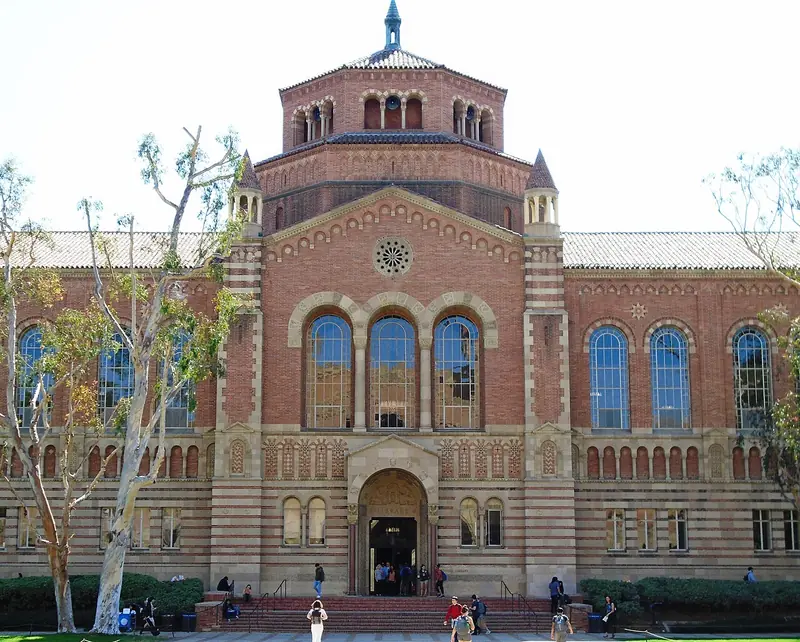

Powell LibraryUniversity of California, Los Angeles
Powell Library was one of the four original buildings of UCLA's Westwood campus. Designed by architect George W. Kelham and built between 1927 and 1929, it is a showpiece of Northern Italian Romanesque Revival architecture, with Moorish touches that nod to California's Spanish heritage. A 45-foot rotunda crowns the reading room. Inside are star-patterned wooden ceilings, tall windows, fine brickwork and mosaic tile, and owls carved on the stair posts. Ray Bradbury wrote an early draft of Fahrenheit 451 on rented typewriters in its basement. A recent seismic retrofit carefully removed and replaced 447 historic ceiling panels and the building is a Los Angeles Conservancy Preservation Award recipient.
Last verified: November 2, 2026. Visitor rules, hours and borrowing policies change, so check the library's website before you go.
About colleges and universities in California
California has three large public higher education systems. The University of California runs 10 campuses, the California State University has 22 universities serving more than 450,000 students, and the California Community Colleges enroll about 2.2 million students at 116 colleges. Many private colleges and universities, including Stanford, Caltech and USC, add to that total.
College libraries are not just for students. Many public university libraries in California let visitors walk in and read on site, and several, including UC Berkeley and UCLA, are federal depository libraries, which give everyone free access to U.S. government information. Borrowing usually requires a paid community or alumni card. Visitor rules differ by campus and often tighten during finals, so check a library's visitor page before you go.